SilverLine may be buried today, but the structural realities that created the idea continue to exist within Kerala’s future.
The formal withdrawal of the K-Rail SilverLine project by the new UDF government marks more than the end of a controversial railway proposal. Chief Minister V.D. Satheesan moved swiftly to officially drop the project and revoke its land acquisition notifications. It marks the temporary suspension of one of the most ambitious mobility visions ever proposed in Kerala’s modern history.
Yet history suggests that ideas of this scale rarely disappear permanently.
Kerala’s Long History of Resistance and Infrastructure
Kerala has never been a region where transformative infrastructure emerges quickly or without resistance. From the early railway extensions during the British colonial period, including the Nilambur line built through dense forest landscapes, to the decades-long evolution that eventually produced projects like the Kochi Metro, major infrastructural shifts in Kerala have always passed through intense public scrutiny, ideological conflict, environmental debate, and political hesitation - building anything here requires an extraordinary amount of societal negotiation, persistence, and time.
SilverLine belonged to that same historical trajectory. While politicians view this as a conclusive end, history suggests they are merely turning the page to a more complex chapter.
More Than a Railway Project
The project was never merely about reducing travel time between Kasaragod and Thiruvananthapuram. It represented a larger proposition: the possibility of reorganising human movement, economic concentration, labour mobility, urban expansion, and regional balance within Kerala itself.
For supporters, SilverLine was envisioned as a structural transformation capable of reshaping daily life across the state with potential to fundamentally alter the state's socio-economic geography, cutting travel times from twelve hours down to just four. For critics, it raised serious concerns involving land acquisition, ecological vulnerability, financial sustainability, and administrative transparency. Both reactions emerged from Kerala’s deeply evolved public sphere: a society where political awareness and social participation are unusually intense compared to much of India.
That tension is precisely why projects in Kerala often move slowly.
The Political Battle Around SilverLine
The CPI(M)-led government treated SilverLine as a flagship vision for Kerala’s future. However, once such a project is politically adopted, sustaining public legitimacy becomes equally important as announcing it. The government’s aggressive push often collided with resistance movements, environmental activism, and anxieties surrounding displacement.
At the same time, the Union Government showed visible discomfort toward the project from its earliest stages. But Kerala's unique social fabric, which made her a global model for human development, also creates a highly critical and protective public sphere. When a state achieves such high standards of living and social equity, opposition becomes inevitable.
Opposition emerged not only through administrative resistance but also through competing transport narratives. Figures such as E. Sreedharan and Union Railway Minister Ashwini Vaishnaw became associated with alternative railway discussions that appeared designed to counter the independent momentum of SilverLine.
In the long phase of the previous government, there was a palpable anxiety at the center that a completely independent, Kerala-run high-speed network would set an unreplicable precedent of state-level autonomy. Just before the political winds shifted this year, an attempt was made by the center to introduce a localized alternative, tasking Sreedharan with preparing a fresh Detailed Project Report (DPR).
Yet, this administrative maneuver dissolved into mere talk within days - proving that the alternative was less about immediate execution and more about disrupting the LDF's momentum, probably an NDA political agenda. Those discussions faded without producing either a comprehensive alternative or a detailed long-term execution framework.
Eventually, both the CPI(M) and the NDA moved away from the project - though for entirely different political reasons.
The Idea Has Not Disappeared
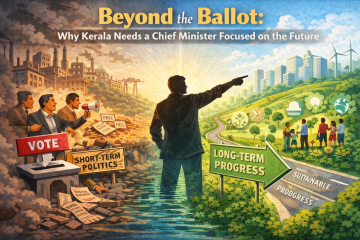
Now the newly established UDF government has chosen to terminate the initiative entirely. Pulling out the controversial yellow boundary stones and recommending the withdrawal of cases against protesters has been celebrated as a major political victory. But in a state with Kerala's geographical bottlenecks, this dismantling affects not only the administrative structure behind the project but also the political foundation laid over years of debate.
But infrastructure history rarely moves in straight lines. The idea does not vanish simply because a project is cancelled.
Many transformative projects initially rejected by society later return in altered forms, supported by new technology, different political conditions, or stronger economic necessity. The social voices that produced SilverLine have not disappeared.
Those structural realities remain.
Conclusion
Ironically, by shutting down SilverLine completely, Kerala’s political class may only be postponing - and indirectly strengthening - the future emergence of a more powerful version of the same idea.
Perhaps not today. Perhaps not under the same name. Perhaps not under the same parties.
Kerala eventually returns to ideas that arise from genuine structural necessity. And SilverLine may ultimately become one of them.
The dream of high-speed connectivity in Kerala is not dead; the current political leadership is inadvertently clearing the deck. They are forcing a clean slate.

SilverLine Is Gone — But the Idea Has Already Entered Kerala’s Future

© 2026 varta.space. All rights reserved.
Comments
No comments yet.